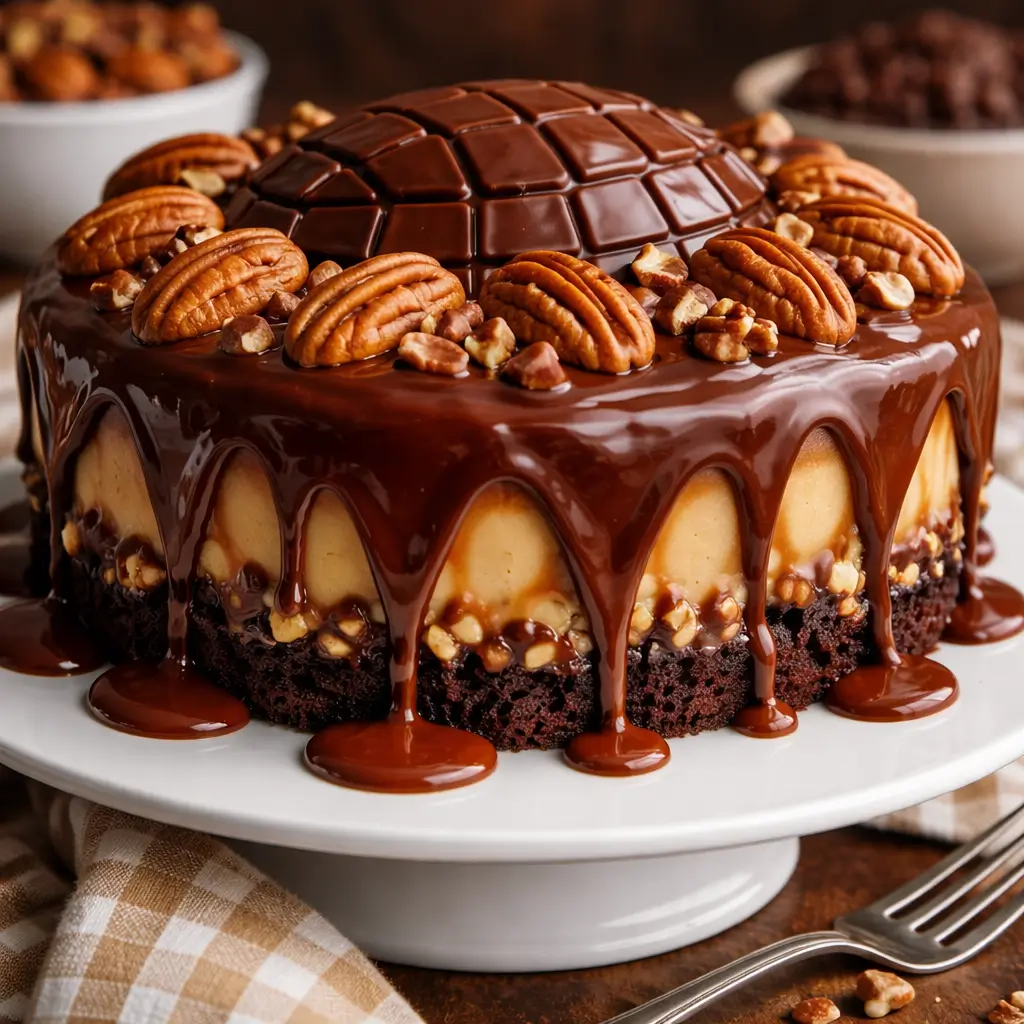
The Layered Turtle Chocolate Cake is a luxurious reinterpretation of the classic turtle candy, combining the fundamental trio of chocolate, caramel, and pecans into a visually dramatic, deeply indulgent cake structure. Unlike traditional sheet cakes, this layered version emphasizes vertical architecture, balanced textures, and controlled sweetness that evolves gradually across multiple strata, thereby producing a refined dessert experience suitable for formal celebrations, gourmet bakeries, and holiday centerpieces.
The Historical Origin of Turtle Desserts
The turtle dessert family originates from early twentieth-century American confectionery, when chocolate-coated caramel and pecans were shaped to resemble turtles and marketed as premium candies. Over the decades, pastry chefs expanded the concept into brownies, cheesecakes, pies, and ultimately layered cakes. The layered turtle chocolate cake represents the apex of this evolution because it unifies the dense chocolate crumb, molten caramel ribbons, nutty crunch, and glossy ganache glaze within a single architectural dessert composition.
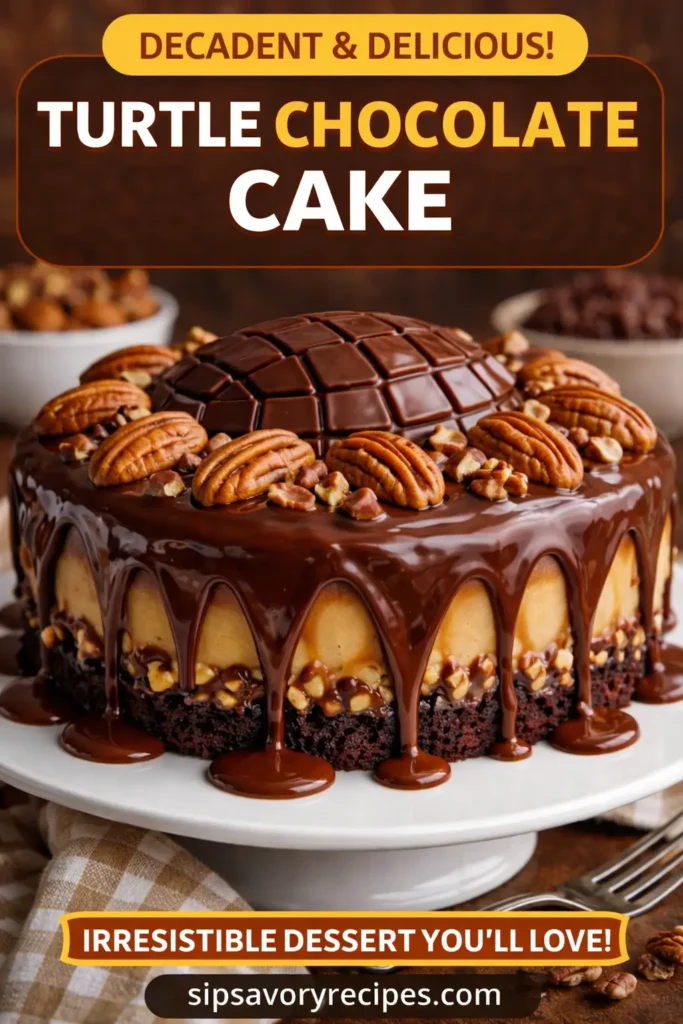
Structural Philosophy of a Layered Turtle Chocolate Cake
A successful layered turtle chocolate cake is not defined merely by ingredient selection but by its structural harmony. The cake must support vertical stacking while maintaining tenderness, which demands precise hydration ratios and controlled baking temperatures. The caramel must remain viscous but not fluid, preventing structural collapse, while pecans must be toasted carefully to release aromatic oils without bitterness. Finally, ganache must be tempered to maintain sheen and elasticity, allowing dramatic dripping without premature solidification.
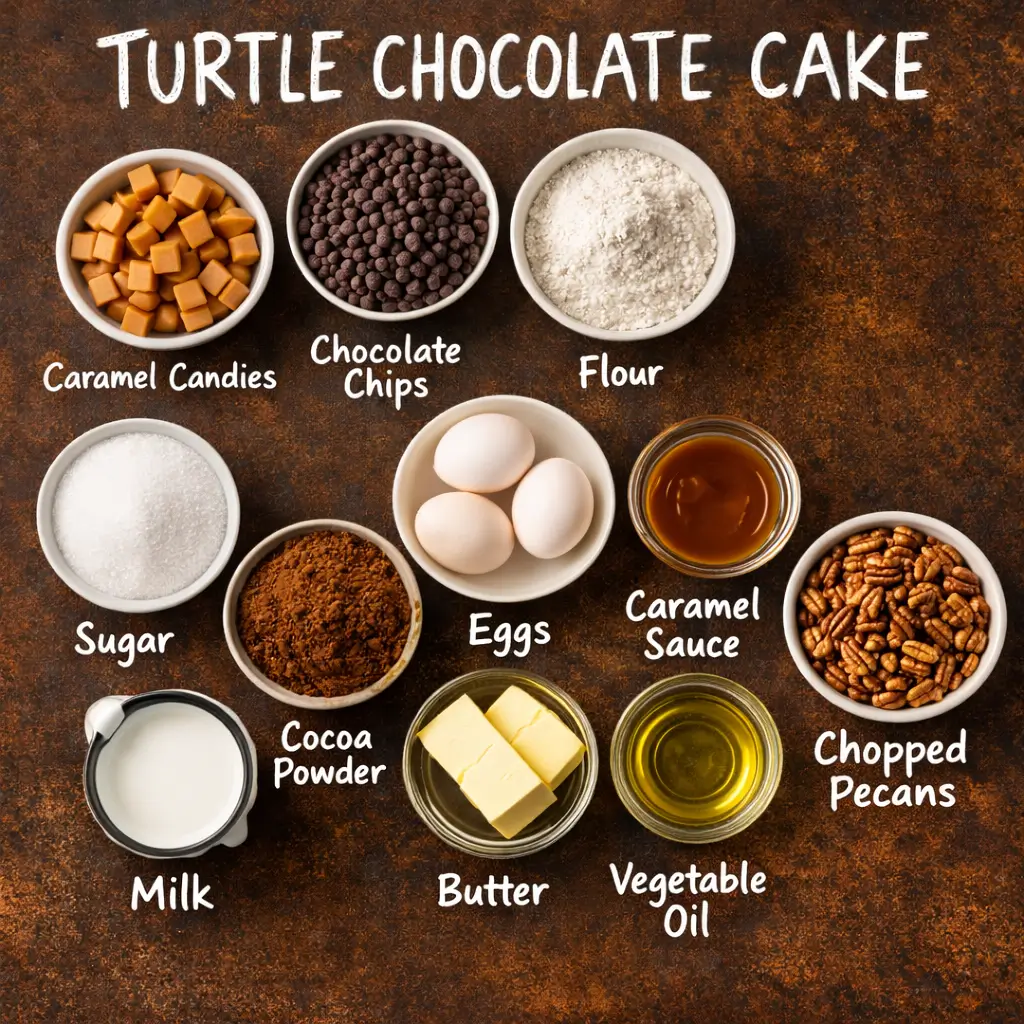
Ingredients
Chocolate Cake Layers
- 2 cups all-purpose flour
- 1 ¾ cups granulated sugar
- ½ cup brown sugar
- ¾ cup unsweetened cocoa powder
- 2 tsp baking powder
- 1 ½ tsp baking soda
- 1 tsp salt
- 2 large eggs
- 1 cup buttermilk
- ½ cup vegetable oil
- 2 tsp vanilla extract
- 1 cup hot brewed coffee
Caramel Sauce
- 1 ½ cups granulated sugar
- ¼ cup water
- 6 tbsp unsalted butter
- ¾ cup heavy cream
- 1 tsp sea salt
Pecan Layer
- 1 ½ cups pecan halves, toasted
- ½ tsp sea salt
Chocolate Ganache
- 10 oz semi-sweet chocolate, chopped
- 1 cup heavy cream
- 2 tbsp unsalted butter
Step-by-Step Instructions
Step 1 – Bake the Cake Layers
- Preheat oven to 350°F (180°C) and line three 8-inch pans with parchment paper.
- Whisk flour, cocoa powder, baking powder, baking soda, and salt in a bowl.
- Beat eggs with both sugars until fluffy.
- Mix in oil, vanilla, and buttermilk.
- Add dry ingredients gradually, alternating with hot coffee.
- Divide batter into pans and bake for 22–25 minutes.
- Cool completely before assembling.
Step 2 – Prepare the Caramel Sauce
- Heat sugar and water in a saucepan without stirring.
- Cook until deep amber color appears.
- Remove from heat and add butter slowly while whisking.
- Stir in cream carefully and return to low heat until smooth.
- Add salt and cool to thick consistency.
Step 3 – Toast the Pecans
- Spread pecans on baking tray.
- Toast at 350°F for 6–8 minutes.
- Let cool and chop half of them.
Step 4 – Make the Ganache
- Heat cream until steaming.
- Pour over chocolate and wait 1 minute.
- Stir until smooth and glossy.
- Mix in butter and allow to thicken slightly.
Step 5 – Assemble the Cake
- Place the first cake layer on the stand.
- Spread ganache, drizzle caramel, and sprinkle chopped pecans.
- Repeat for the second layer.
- Place the final cake layer on top and chill for 20 minutes.
Step 6 – Turtle Finish
- Pour ganache over the top, allowing drips to form.
- Drizzle caramel overthe edges.
- Decorate with whole pecans and an optional chocolate dome.
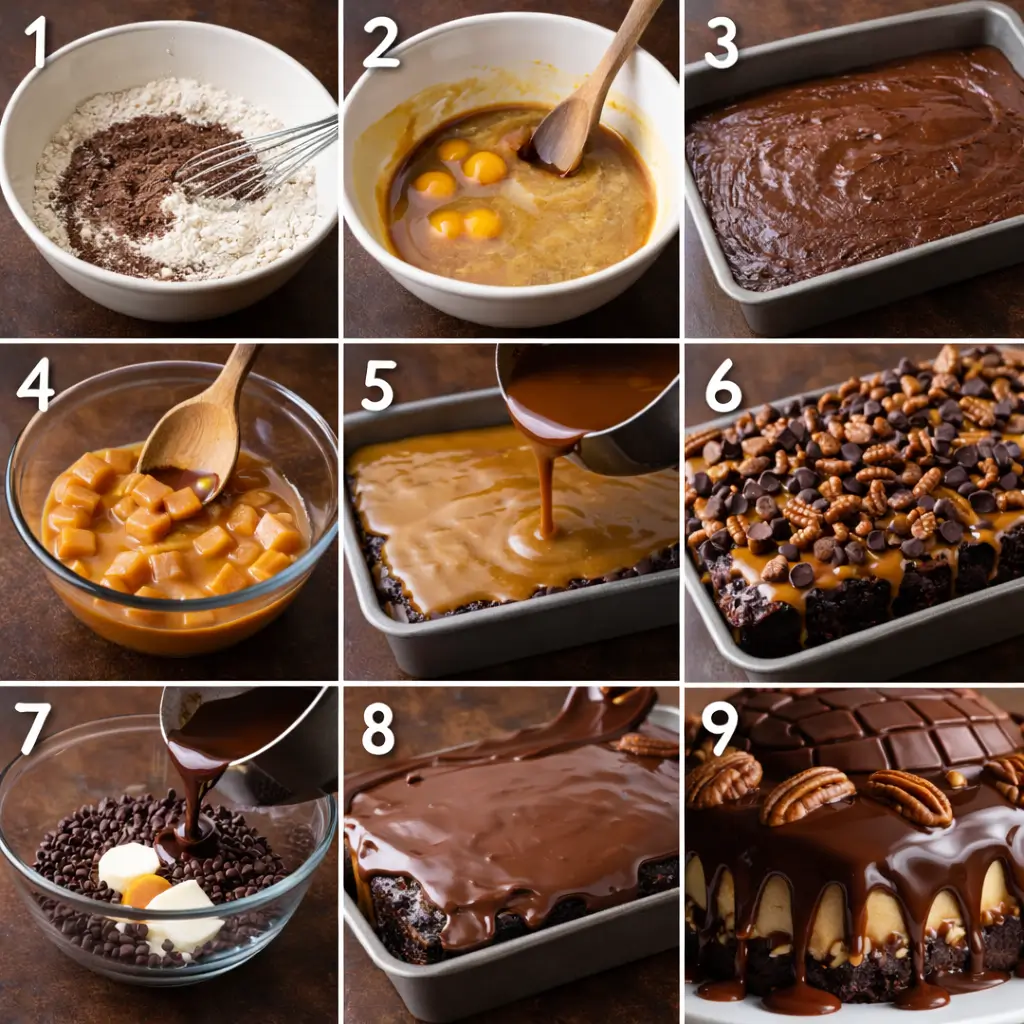
This cake is now ready to serve as a stunning centerpiece dessert. 🍫🐢
Ingredient Science and Flavor Development
Chocolate flavor in layered turtle cake is driven primarily by cocoa concentration and fat content. Natural cocoa powder yields sharper acidity, while Dutch-processed cocoa produces a darker, smoother profile. The presence of hot brewed coffee in the batter amplifies volatile cocoa aromatics through solubilization of hydrophobic flavor compounds, thereby intensifying perceived chocolate depth without imparting coffee flavor. Caramel flavor complexity arises from controlled sucrose pyrolysis, where monosaccharide decomposition produces over one hundred flavor molecules, including maltol, diacetyl, and furanones, responsible for toasted, buttery, and nutty sensory notes.
The Role of Buttermilk and Oil in Crumb Architecture
Buttermilk introduces lactic acid, which softens gluten formation, creating a supple crumb structure while simultaneously enhancing Maillard browning reactions during baking. Vegetable oil is favored over butter because it remains liquid at refrigeration temperatures, preventing crumb stiffening and preserving tenderness throughout storage. Eggs act as emulsifiers that stabilize fat-water interactions while contributing lecithin for improved batter homogeneity.
The Physics of Caramel Stability
Caramelization begins at approximately 160°C, at which point sucrose molecules undergo dehydration and fragmentation into reactive carbonyl intermediates. The addition of butter introduces milk solids that further participate in Maillard browning, while cream halts thermal decomposition and creates an emulsion through lipid dispersion. Proper temperature control is critical because overheating results in bitter polyaromatic compounds, whereas underheating produces cloyingly sweet syrup lacking complexity.
Chocolate Ganache Rheology
Ganache is a metastable emulsion formed from melted cocoa butter crystals dispersed in aqueous cream proteins. When the chocolate-to-cream ratio exceeds 2:1, ganache behaves as a viscoplastic fluid that thickens upon cooling yet retains flow under stress, making it ideal for controlled drip applications. Butter addition further lowers viscosity and enhances gloss by stabilizing polymorphic cocoa butter crystal forms.
Assembly Strategy and Load Distribution
Layering must follow a strict order to ensure stability. The base cake layer must be structurally robust to support the gravitational load of caramel and ganache. Each filling layer should be thin and evenly distributed to prevent lateral shear forces that cause sliding. A brief refrigeration period between stacking allows partial crystallization of fats, increasing friction coefficients between layers and stabilizing the vertical column.
Aesthetic Engineering of the Turtle Effect
The turtle aesthetic emerges through radial placement of pecans along the perimeter and the central chocolate dome that simulates a turtle shell. This dome not only provides visual symbolism but also reinforces vertical symmetry, preventing viewer’s perception of collapse or asymmetry. The caramel drip pattern is governed by Newtonian flow mechanics, where viscosity, surface tension, and gravitational acceleration determine droplet size and spacing, producing the iconic molten cascade effect.
Sensory Experience and Palate Progression
The first bite delivers immediate ganache richness, followed by caramel warmth that melts on the tongue, culminating in toasted pecan crunch and chocolate crumb softness. The multi-stage flavor release ensures sustained palate engagement rather than abrupt sweetness saturation, making the cake satisfying even in small portions.
Shelf Life and Storage Optimization
The layered turtle chocolate cake maintains peak quality for five days under refrigeration at 4°C. Caramel moisture migration is limited by ganache fat barriers, while cake crumb moisture remains stable due to oil emulsification. Freezing is discouraged because caramel crystallization alters texture and pecans lose aromatic integrity.
Nutritional Considerations
Although indulgent, this cake offers trace minerals from cocoa, including magnesium, copper, and iron, while pecans contribute monounsaturated fats and antioxidant polyphenols. Portion control remains essential due to the high caloric density, which exceeds 480 kcal per slice.
Common Failure Modes
Layer slippage typically results from over-warm caramel application, while ganache dullness indicates improper cocoa butter crystallization. Grainy caramel signifies premature stirring or sugar recrystallization, which can be prevented by avoiding agitation during melting.
Culinary Applications and Serving Contexts
This cake excels at holiday dinners, upscale birthday celebrations, Valentine’s Day events, and bakery display cases, where visual drama is as critical as flavor complexity. It pairs exceptionally with espresso, port wine, or bourbon, whose tannic profiles counterbalance caramel sweetness.
Final Reflection
The layered turtle chocolate cake is not merely a dessert but an engineered culinary system that harmonizes chemistry, physics, and sensory artistry. Its enduring popularity arises from its ability to transform nostalgic turtle candy flavors into a modern architectural masterpiece that satisfies emotional, aesthetic, and gastronomic expectations simultaneously.
