
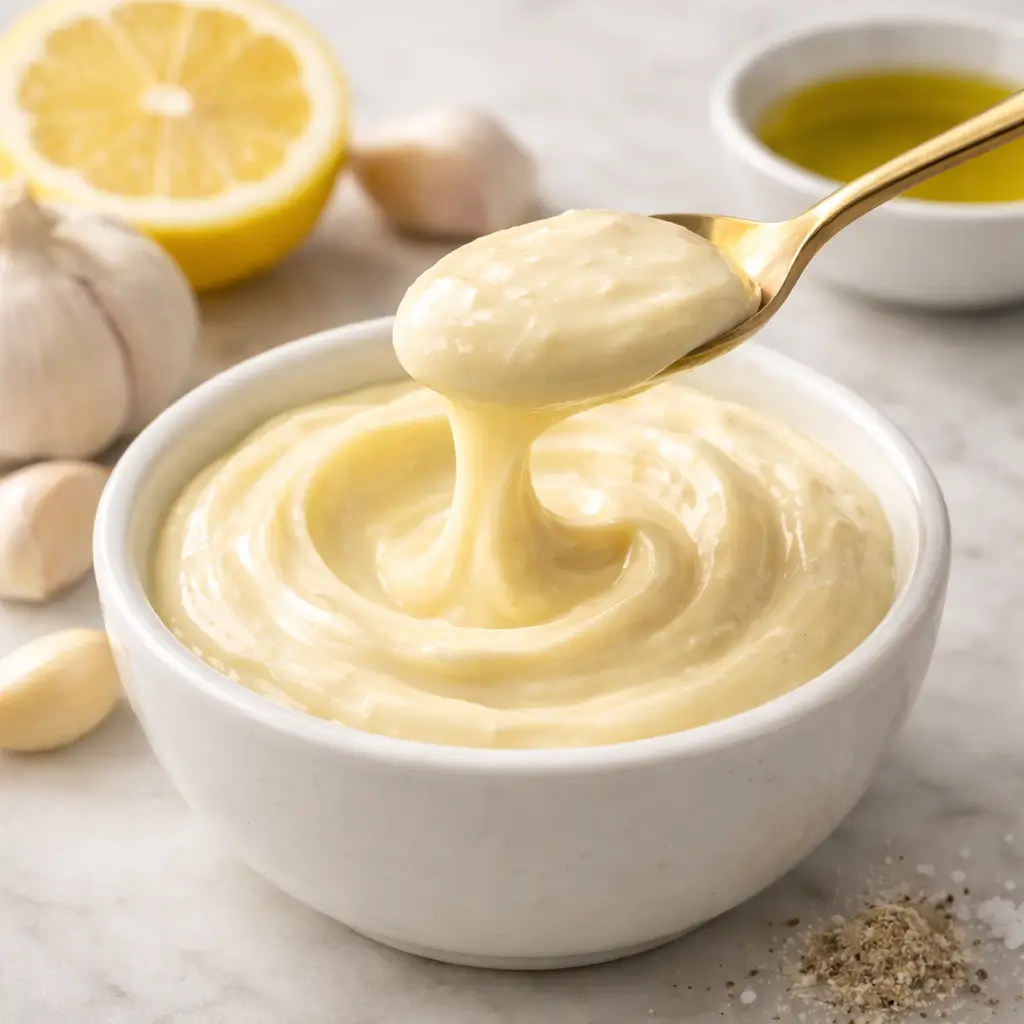
Garlic aioli is a foundational Mediterranean sauce built on a simple but exacting principle: the stable emulsification of oil into a garlic-infused base. When prepared correctly, aioli is thick, smooth, and cohesive, with a clean garlic flavor supported by acidity and richness rather than overwhelmed by it. This garlic aioli sauce recipe focuses on classical technique, controlled ratios, and ingredient behavior, ensuring consistent results suitable for both professional kitchens and serious home cooks.
Aioli is often misunderstood as flavored mayonnaise. While modern preparations frequently resemble mayonnaise in structure, traditional aioli emphasizes garlic and olive oil as dominant elements. The use of egg yolk, although historically debated, provides reliable emulsification and allows for repeatable texture. This recipe adopts the egg-yolk method intentionally, prioritizing stability, balance, and instructional clarity.
This article explains not only how to prepare garlic aioli, but why each step matters. Ingredient selection, temperature control, oil choice, and mixing speed all affect the final sauce. By understanding these factors, the cook gains the ability to adjust flavor, texture, and yield without compromising structure.
Understanding Emulsification in Aioli
An emulsion is a dispersion of fat droplets within a water-based phase. In garlic aioli, oil is dispersed into a mixture containing egg yolk, garlic, and acid. Egg yolks contain lecithin, a natural emulsifier that stabilizes oil droplets and prevents separation. Proper emulsification depends on gradual oil incorporation and constant mechanical agitation.
If oil is added too quickly, droplets coalesce and the emulsion breaks. If agitation stops, oil separates. Successful aioli therefore requires patience and consistency rather than speed. Once the emulsion forms, it becomes increasingly stable, allowing for faster oil incorporation near the end of mixing.
Ingredient Selection and Function
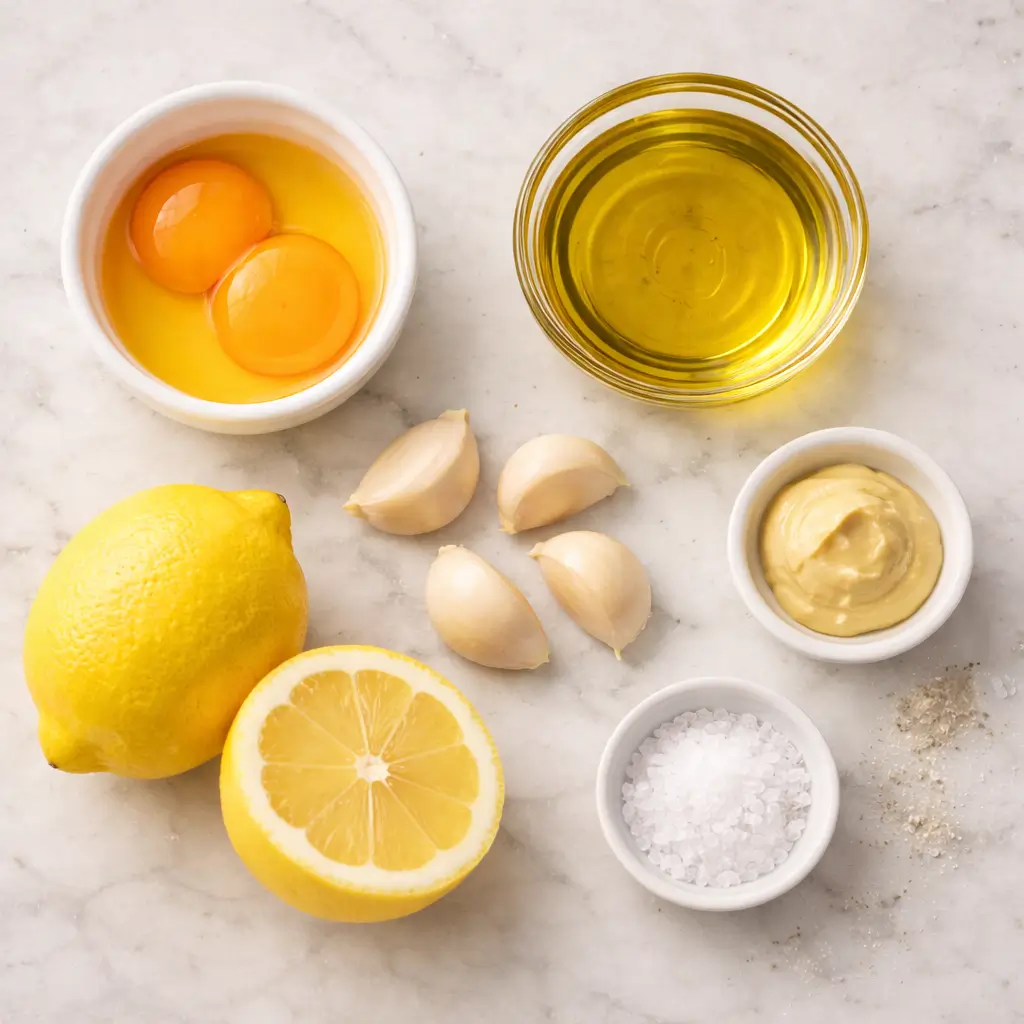
Garlic is the defining flavor. Fresh, firm cloves should be used, free from sprouting or soft spots. The green germ inside older cloves contributes bitterness and should be removed when present. Garlic must be processed into a fine paste to prevent uneven flavor and textural defects.
Egg yolks serve as the emulsifying base. They should be fresh and preferably at room temperature to improve dispersion. Pasteurized yolks may be used for food safety without compromising structure.
Oil provides body and richness. Extra-virgin olive oil offers traditional flavor but can introduce bitterness if used alone. For this reason, many professional kitchens blend olive oil with a neutral oil such as sunflower or grapeseed. This recipe reflects that practice, balancing flavor with stability.
Acid brightens the sauce and counteracts fat. Fresh lemon juice is preferred for its aroma and mild acidity. Vinegar may be substituted, but it produces a sharper profile. Acid should always be added after the emulsion forms to avoid destabilization.
Salt enhances flavor and improves balance. Fine sea salt dissolves evenly and allows for precise seasoning. Dijon mustard is optional but may be used in small quantities to reinforce emulsification without altering flavor identity.
Equipment Considerations
Garlic aioli may be prepared by hand or with a food processor. Hand-whisking offers maximum control and develops tactile understanding of emulsification. A food processor increases speed and consistency but requires attention to oil flow and mixing duration.
Regardless of method, the bowl should be stable, the whisk or blade clean, and all ingredients prepared in advance. Interruptions during emulsification increase the risk of failure.
Classical Hand-Whisked Method
The hand-whisked method emphasizes precision and feedback. Garlic is first reduced to a smooth paste using a knife or mortar. This paste is combined with egg yolks in a mixing bowl and whisked until homogeneous. At this stage, the mixture should appear slightly thickened and uniform.
Oil is then introduced drop by drop while whisking continuously. During the initial phase, the mixture may appear loose and resistant. After sufficient oil has been incorporated, the emulsion will suddenly tighten and thicken. This transition indicates successful droplet dispersion.
Once the emulsion forms, oil may be added in a thin, steady stream. Whisking must remain constant, but the process becomes more forgiving. When the desired volume and thickness are reached, lemon juice is added gradually, followed by salt. The finished aioli should be glossy, cohesive, and capable of holding soft peaks.
Food Processor Method
In the food processor method, garlic and egg yolks are processed briefly to combine. With the machine running, oil is added very slowly through the feed tube. Early restraint is critical. Once the emulsion forms, oil flow may be increased slightly. Lemon juice and salt are added at the end, and the mixture is pulsed just until incorporated.
Overprocessing introduces excess air and may thin the sauce. For this reason, processing should stop as soon as the aioli reaches proper consistency.
Exact Ingredient Quantities (Scaling Table)
The following table provides precise quantities for consistent results. Measurements are given in both US customary units and metric equivalents. These ratios maintain structural integrity across batch sizes.
| Ingredient | 2 Servings | 4 Servings | 6 Servings |
|---|---|---|---|
| Egg yolks | 1 | 2 | 3 |
| Garlic cloves (peeled) | 1–2 | 3 | 4–5 |
| Extra-virgin olive oil | 1/4 cup (60 ml) | 1/2 cup (120 ml) | 3/4 cup (180 ml) |
| Neutral oil | 1/4 cup (60 ml) | 1/2 cup (120 ml) | 3/4 cup (180 ml) |
| Fresh lemon juice | 1–2 tsp | 1 tbsp | 1 1/2 tbsp |
| Fine sea salt | 1/4 tsp | 1/2 tsp | 3/4 tsp |
| Dijon mustard (optional) | 1/4 tsp | 1/2 tsp | 3/4 tsp |
Garlic quantity may be adjusted based on strength and freshness. Oil ratios may be modified slightly to favor olive oil once technique is mastered.
Step-by-Step Instructions (Hand-Whisked Method)
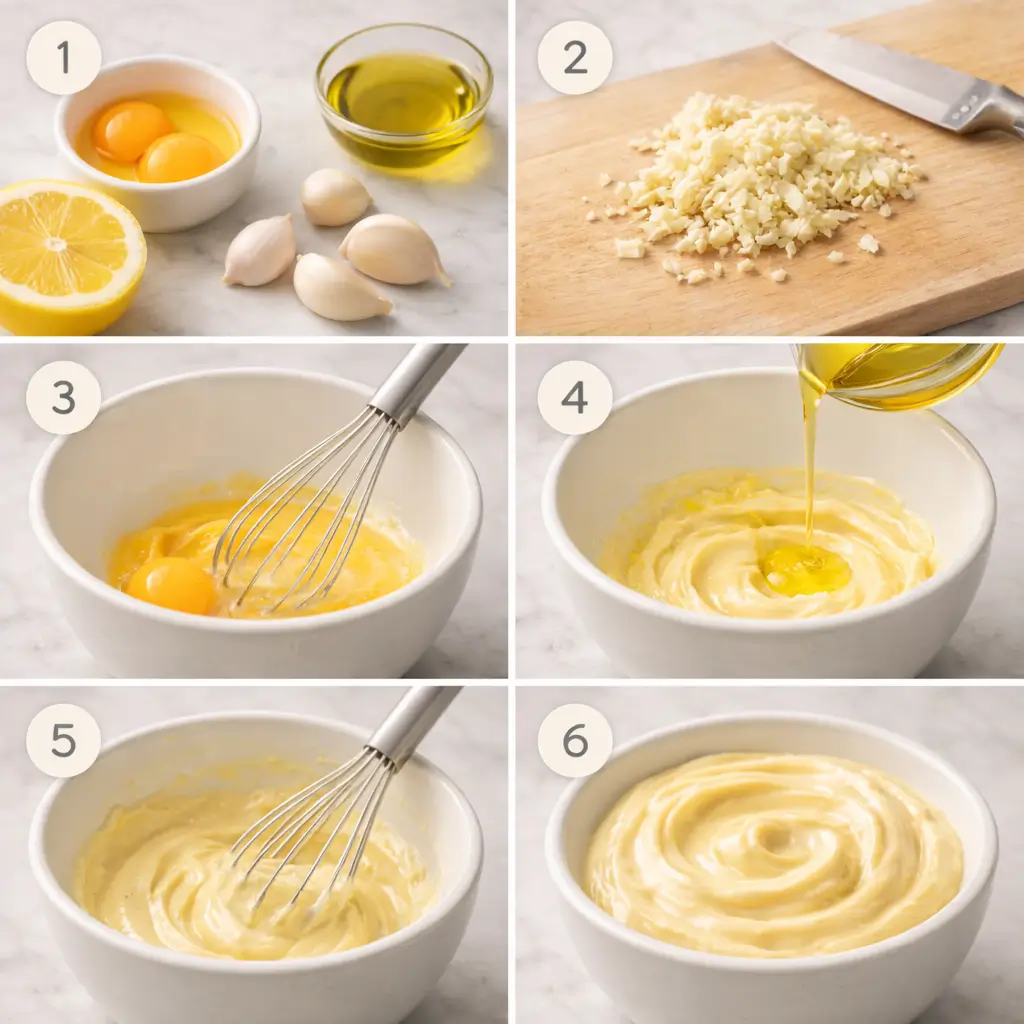
- Prepare the garlic. Peel the garlic cloves. Split each clove lengthwise and remove the green germ if present. Mince the garlic finely, then press and drag the knife edge over it with a pinch of salt until a smooth paste forms.
- Build the base. In a medium bowl, combine the egg yolk(s), garlic paste, and Dijon mustard (if using). Whisk until completely homogeneous and slightly thickened.
- Start the emulsion slowly. While whisking continuously, add the oil drop by drop for the first minute. Keep the bowl steady and do not stop whisking. Continue until the mixture begins to look creamy and starts to hold together.
- Increase to a thin stream. Once the emulsion has formed, add the oil in a very thin, steady stream while whisking constantly. If the sauce looks glossy and thick, you may slightly increase the flow, but keep it controlled.
- Check texture and adjust. When all oil is incorporated, the aioli should be thick, smooth, and cohesive. If it is too thick, whisk in 1–2 teaspoons water (or lemon juice) to loosen. Add only a little at a time.
- Season and brighten. Whisk in the lemon juice gradually, tasting after each addition. Add fine sea salt in small pinches until the flavor is balanced. The finished aioli should taste rich, clean, and distinctly garlicky without bitterness.
- Rest and store. Let the aioli rest for 5–10 minutes to stabilize, then transfer to an airtight container. Refrigerate and use within 48 hours. Stir briefly before serving.
Texture Management and Adjustment
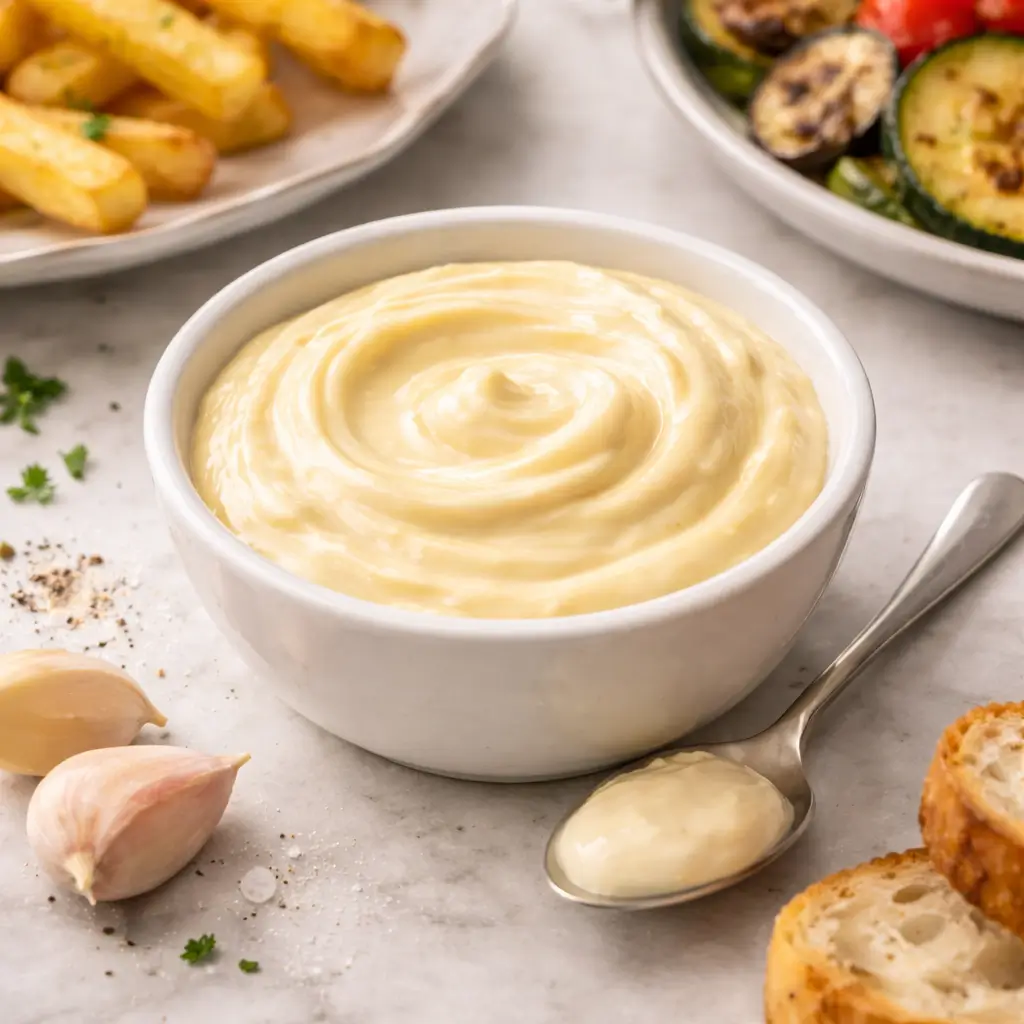
Proper garlic aioli should be thick yet supple. It should cling to food without appearing stiff or pasty. If the sauce becomes too thick, a small amount of water may be whisked in, one teaspoon at a time, until the desired texture is achieved. If the sauce is too thin, additional oil may be incorporated slowly to rebuild structure.
Temperature affects viscosity. Aioli thickens slightly when chilled and loosens at room temperature. Adjustments should therefore be made with final serving temperature in mind.
Common Failures and Corrections
A broken aioli results from oil being added too quickly or insufficient agitation. To repair a broken sauce, begin with a fresh egg yolk in a clean bowl and slowly whisk the broken mixture into it, treating it as the oil phase. Stability can often be restored.
Bitterness typically originates from aggressive olive oil or garlic germ. Balancing with neutral oil and removing the garlic germ prevents this issue. Excess acidity may be corrected by adding a small amount of oil, while blandness requires careful salting rather than additional garlic.
Flavor Variations Built on the Base Recipe
Once the base garlic aioli is mastered, variations can be developed without compromising structure. Roasted garlic produces a sweeter, milder profile and is appropriate for heavier dishes. Increased lemon juice creates a brighter sauce suitable for seafood. Chili paste or smoked paprika may be added sparingly for heat, provided they are fully incorporated and balanced with fat.
Herbs should be added only after emulsification and must be finely chopped to prevent separation.
Culinary Applications
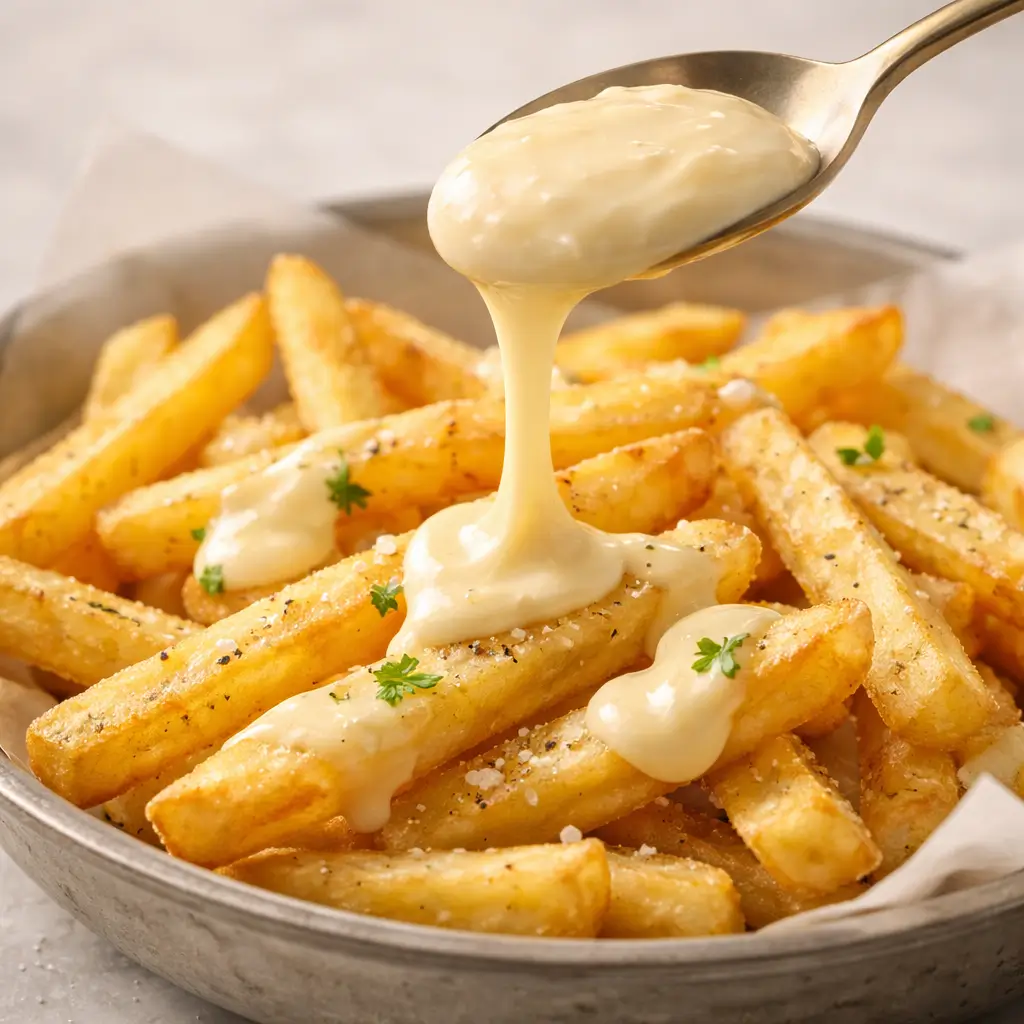
Garlic aioli is traditionally served with fried potatoes, grilled vegetables, and seafood. It functions equally well as a sandwich spread, burger condiment, or accompaniment to roasted meats. Because of its richness, it should be applied judiciously, allowing the base ingredient to remain prominent.
In professional kitchens, aioli is often thinned slightly for plating or adjusted with stock for use as a sauce rather than a dip.
Storage and Food Safety
Garlic aioli is a fresh preparation and should be treated accordingly. It must be stored in an airtight container under refrigeration and consumed within forty-eight hours. Because it contains raw egg yolk and garlic, it should not be left at room temperature for extended periods.
Aioli should never be frozen, as freezing destroys the emulsion. Any change in odor, color, or texture indicates spoilage and requires disposal.
Frequently Asked Questions
Can garlic aioli be made without eggs?
Yes. Aioli can be prepared without eggs by using an alternative emulsifier such as aquafaba, milk, or a small amount of mustard. However, the texture will be lighter and less stable than an egg-yolk–based aioli, and the flavor profile will differ slightly.
Why did my aioli break while mixing?
Aioli usually breaks when oil is added too quickly or when whisking stops during emulsification. Temperature differences between ingredients can also contribute. To fix a broken aioli, start with a fresh egg yolk in a clean bowl and slowly whisk the broken sauce into it as if it were the oil.
Is garlic aioli the same as mayonnaise?
No. While both are emulsified sauces, mayonnaise is typically made with neutral oil and vinegar and has a mild flavor. Garlic aioli emphasizes garlic and olive oil, resulting in a stronger, more aromatic sauce, even when egg yolks are used.
Why does my aioli taste bitter?
Bitterness usually comes from aggressive extra-virgin olive oil or from the green germ inside older garlic cloves. Blending olive oil with a neutral oil and removing the garlic germ prevents this issue.
How thick should garlic aioli be?
Properly made aioli should be thick enough to coat a spoon and cling to food without dripping. It should remain smooth and supple, not stiff or pasty. Texture can be adjusted with small amounts of water or oil.
Can I use a blender instead of a whisk or food processor?
A blender can be used, but it increases the risk of over-processing and incorporating too much air. If using a blender, add oil very slowly and stop as soon as the aioli reaches the correct consistency.
How long does homemade garlic aioli last?
Garlic aioli should be refrigerated immediately and used within 48 hours. Because it contains raw egg yolk and garlic, it should not be left at room temperature for extended periods.
Can garlic aioli be frozen?
No. Freezing breaks the emulsion and ruins the texture. Aioli should always be made fresh.
Can I add herbs or spices to aioli?
Yes, but only after the emulsion is complete. Finely chopped herbs or spices should be added gently to avoid breaking the sauce and to maintain balance.
What foods pair best with garlic aioli?
Garlic aioli pairs particularly well with fries, roasted vegetables, grilled seafood, sandwiches, and burgers. Its richness works best with simple, well-seasoned foods rather than heavily sauced dishes.
Conclusion
This garlic aioli sauce recipe emphasizes technique over speed and understanding over approximation. By controlling ingredient ratios, oil incorporation, and seasoning order, the cook gains a reliable method capable of scaling and adaptation. Mastery of aioli reinforces broader principles of emulsification that apply across classical and modern sauces.
When prepared with care, garlic aioli is not merely a condiment but a demonstration of culinary control. Its simplicity is deceptive, and its success depends entirely on precision, patience, and respect for process.
